




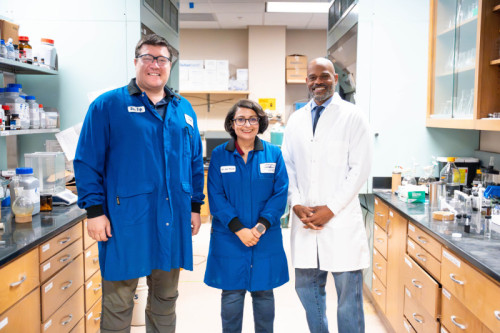
- $2 Million Grant to Benefit Chemistry and Biochemistry StudentsThe STEM field is a continuously growing community with many job opportunities available for science students. Cal State San Marcos is committed to providing the resources and support these students need to pursue higher education and integrate themselves into the workforce. That commitment received a boost recently, as CSUSM was awarded a $2 million grant from the National Science Foundation to create a learning community for chemistry and biochemistry majors and award scholarships to qualified students. The program will incorporate a Vertical Mentoring Learning Community (VMLC) for up to 30 chemistry and biochemistry students each year, with eight first-year students receiving a renewable $15,000 scholarship based on financial need. The program is led by chemistry and biochemistry professor Robert Iafe, the principal investigator, and co-principal investigators Afra Panahi, a chemistry and biochemistry professor, and Aswad Allen, CSUSM’s chief diversity officer. Together, they plan to create a community of high-achieving, motivated students recruited from introductory chemistry classes. Students who prove proficient and committed to their studies will be invited to join the learning community, and those who qualify financially will be able to apply for the additional scholarship to help with tuition and housing. “The community aspect of it gives it a supportive place to really go for your goals, but also a safe and secure place to experiment,” Iafe said. Students selected for the VMLC also will receive priority enrollment for chemistry classes and labs required for their major. The vertical mentoring learning experience highlights a discipline-specific learning community of students supported by each other, faculty members and professionals. This offers students a comfortable learning environment filled with like-minded individuals guiding them toward their futures in STEM, whether that be graduate school or pursuing a career. “We make sure they participate in professional development activities so they can build a strong science identity and become more competitive for graduate school and the job market,” Panahi said. “The supportive environment from their peer mentors, academic advisers and professional mentors can really help them build a stronger network.” The smaller, more intimate setting of the vertical mentoring program provides a comfortable space for students to ask questions freely and create a closer relationship with faculty. This environment creates a rewarding experience for all and promotes a sense of happiness and job satisfaction among the faculty involved. “There are concrete benchmarks along the way for students to actually see themselves progressing,” Allen said. "Vertical learning allows students to visualize their futures and see themselves where they want to be. “We're going to create the right atmosphere, the right environment and all the right ingredients for them to thrive.” Learn more on the Vertical Mentoring Learning Community website. Media Contact Eric Breier, Interim Assistant Director of Editorial and External Affairs ebreier@csusm.edu | Office: 760-750-7314
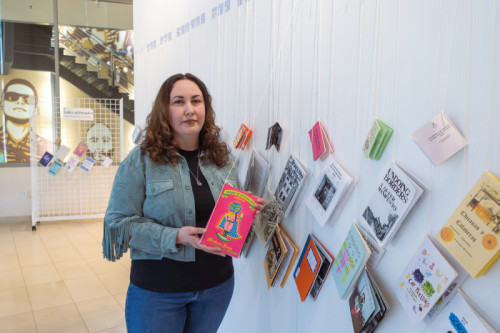
- New Library Exhibit Explores World of ZinesIt’s fitting that the title of the new art exhibit on the third floor of Kellogg Library is “Zine Dreams.” April Ibarra Siqueiros, the curator of the exhibit and a user experience librarian at Cal State San Marcos, does indeed dream of zines – short for “magazine,” the term refers to handmade publications in booklet form about any topic, presented as an alternative to mainstream media. Siqueiros dreams about the zines she wants to make. She dreams about the zines she wants to add to her growing collection. And she dreams about the zine community that she wants to cultivate at CSUSM. Her current exhibit in the library – part of the biannual Context Exhibit Series, it’s on display in person or online through Dec. 15 – is a big step in that direction. Subtitled “publishing in your hands,” the exhibit is essentially a love letter to zine culture told through Siqueiros’ creative eye and curious mind. It features about 60 zines from her personal collection – covering such topics as borders, immigration, art, gender and sexuality – and a dozen more that she has made, either by herself or with a group. It also includes information about the process of zine-making, the history of zines and the local zine community. “Zines can be a way for marginalized and oppressed voices to use a format to share their stories, make calls to action, teach something and build community,” Siqueiros said. “They can also be random, silly and made to bring joy. It's a format that is open to all, regardless of skill level. “Sometimes I hear someone say they aren't an artist or ‘creative’ when it comes to zine making, but in my experience teaching zine workshops, that doesn't matter. If someone intentionally explores zine making, it is likely a cool zine will come out of it.” Growing up in the South Bay, Siqueiros says she was always a crafty child. She remembers first hearing about zines from a Nickelodeon cartoon in the early 2000s, and she bought her first one in 2008 – a Mexican cookzine called “Vegan de Guadalupe” (a play on veganism and the Virgin Mary), it’s included in the exhibit. Siqueiros crossed over from simply collecting zines to making them about a decade ago when she was pursuing a master’s degree in library and information science at the Pratt Institute in New York. Inspired by attending the Brooklyn Zine Fest, she created her initial zine as part of an art collective with some friends. A year later, she displayed her first solo zine at the same festival. “Having been an artist and crafter, I’ve always gravitated to making things,” she said. “Zines opened up another realm of creating for me, which stuck 10 years later.” Most of zines Siqueiros has made fall under the general theme she conjured up called “Valley of Paradox.” Of those, she’s proudest of one named “Celestial Hearts: deep connections with deep space,” which is about her love of astronomy. It represented a leap forward for her in ambition, creativity and research, and about half of it is contributed content from fellow zinesters who responded to a call for submission. She’s working on a second and third part of the series, which will focus alternately on her personal astronomical adventures and stories, and research about astronomers and space explorers. Siqueiros has worked for the CSUSM library since 2019, and during that time she gradually has become exposed to an interest in zines by the campus community – whether it’s professors incorporating zines into their assignments or colleagues who make them or are just intrigued by them. She began thinking about curating the exhibit two years ago, and her desire to pursue it was reinforced as she taught zine workshops for a few instructors, including Dominque Harrison, who works for the Office of Institutional Planning & Analysis but also teaches a seminar for first-year students. Three zines created during Harrison’s class last summer are on display in the exhibit. “While zines are not mainstream, it just takes a zine point person to open up this format to someone’s world,” Siqueiros said. She would like to be that person for any number of students who stroll by her exhibit this semester. But she doesn’t want “Zine Dreams” to be only a passive experience. The goal is to unlock others’ zine-making potential. On Oct. 9 from 1-2 p.m., Siqueiros will collaborate with the Common Read program on a workshop in The Makery where students can create a page in a collective zine that highlights their identities and stories. “It might take someone years later to make one like it did for me,” she said. “Minimally, my hope is that anyone who sees the exhibit reflects on the power of DIY publishing and how zines provide a way for us to learn about things that we may never be exposed to otherwise.” Media Contact Brian Hiro, Communications Specialist bhiro@csusm.edu | Office: 760-750-7306
- $2 Million Grant to Benefit Chemistry and Biochemistry StudentsThe STEM field is a continuously growing community with many job opportunities available for science students. Cal State San Marcos is committed to providing the resources and support these students need to pursue higher education and integrate themselves into the workforce. That commitment received a boost recently, as CSUSM was awarded a $2 million grant from the National Science Foundation to create a learning community for chemistry and biochemistry majors and award scholarships to qualified students. The program will incorporate a Vertical Mentoring Learning Community (VMLC) for up to 30 chemistry and biochemistry students each year, with eight first-year students receiving a renewable $15,000 scholarship based on financial need. The program is led by chemistry and biochemistry professor Robert Iafe, the principal investigator, and co-principal investigators Afra Panahi, a chemistry and biochemistry professor, and Aswad Allen, CSUSM’s chief diversity officer. Together, they plan to create a community of high-achieving, motivated students recruited from introductory chemistry classes. Students who prove proficient and committed to their studies will be invited to join the learning community, and those who qualify financially will be able to apply for the additional scholarship to help with tuition and housing. “The community aspect of it gives it a supportive place to really go for your goals, but also a safe and secure place to experiment,” Iafe said. Students selected for the VMLC also will receive priority enrollment for chemistry classes and labs required for their major. The vertical mentoring learning experience highlights a discipline-specific learning community of students supported by each other, faculty members and professionals. This offers students a comfortable learning environment filled with like-minded individuals guiding them toward their futures in STEM, whether that be graduate school or pursuing a career. “We make sure they participate in professional development activities so they can build a strong science identity and become more competitive for graduate school and the job market,” Panahi said. “The supportive environment from their peer mentors, academic advisers and professional mentors can really help them build a stronger network.” The smaller, more intimate setting of the vertical mentoring program provides a comfortable space for students to ask questions freely and create a closer relationship with faculty. This environment creates a rewarding experience for all and promotes a sense of happiness and job satisfaction among the faculty involved. “There are concrete benchmarks along the way for students to actually see themselves progressing,” Allen said. "Vertical learning allows students to visualize their futures and see themselves where they want to be. “We're going to create the right atmosphere, the right environment and all the right ingredients for them to thrive.” Learn more on the Vertical Mentoring Learning Community website. Media Contact Eric Breier, Interim Assistant Director of Editorial and External Affairs ebreier@csusm.edu | Office: 760-750-7314
- New Library Exhibit Explores World of ZinesIt’s fitting that the title of the new art exhibit on the third floor of Kellogg Library is “Zine Dreams.” April Ibarra Siqueiros, the curator of the exhibit and a user experience librarian at Cal State San Marcos, does indeed dream of zines – short for “magazine,” the term refers to handmade publications in booklet form about any topic, presented as an alternative to mainstream media. Siqueiros dreams about the zines she wants to make. She dreams about the zines she wants to add to her growing collection. And she dreams about the zine community that she wants to cultivate at CSUSM. Her current exhibit in the library – part of the biannual Context Exhibit Series, it’s on display in person or online through Dec. 15 – is a big step in that direction. Subtitled “publishing in your hands,” the exhibit is essentially a love letter to zine culture told through Siqueiros’ creative eye and curious mind. It features about 60 zines from her personal collection – covering such topics as borders, immigration, art, gender and sexuality – and a dozen more that she has made, either by herself or with a group. It also includes information about the process of zine-making, the history of zines and the local zine community. “Zines can be a way for marginalized and oppressed voices to use a format to share their stories, make calls to action, teach something and build community,” Siqueiros said. “They can also be random, silly and made to bring joy. It's a format that is open to all, regardless of skill level. “Sometimes I hear someone say they aren't an artist or ‘creative’ when it comes to zine making, but in my experience teaching zine workshops, that doesn't matter. If someone intentionally explores zine making, it is likely a cool zine will come out of it.” Growing up in the South Bay, Siqueiros says she was always a crafty child. She remembers first hearing about zines from a Nickelodeon cartoon in the early 2000s, and she bought her first one in 2008 – a Mexican cookzine called “Vegan de Guadalupe” (a play on veganism and the Virgin Mary), it’s included in the exhibit. Siqueiros crossed over from simply collecting zines to making them about a decade ago when she was pursuing a master’s degree in library and information science at the Pratt Institute in New York. Inspired by attending the Brooklyn Zine Fest, she created her initial zine as part of an art collective with some friends. A year later, she displayed her first solo zine at the same festival. “Having been an artist and crafter, I’ve always gravitated to making things,” she said. “Zines opened up another realm of creating for me, which stuck 10 years later.” Most of zines Siqueiros has made fall under the general theme she conjured up called “Valley of Paradox.” Of those, she’s proudest of one named “Celestial Hearts: deep connections with deep space,” which is about her love of astronomy. It represented a leap forward for her in ambition, creativity and research, and about half of it is contributed content from fellow zinesters who responded to a call for submission. She’s working on a second and third part of the series, which will focus alternately on her personal astronomical adventures and stories, and research about astronomers and space explorers. Siqueiros has worked for the CSUSM library since 2019, and during that time she gradually has become exposed to an interest in zines by the campus community – whether it’s professors incorporating zines into their assignments or colleagues who make them or are just intrigued by them. She began thinking about curating the exhibit two years ago, and her desire to pursue it was reinforced as she taught zine workshops for a few instructors, including Dominque Harrison, who works for the Office of Institutional Planning & Analysis but also teaches a seminar for first-year students. Three zines created during Harrison’s class last summer are on display in the exhibit. “While zines are not mainstream, it just takes a zine point person to open up this format to someone’s world,” Siqueiros said. She would like to be that person for any number of students who stroll by her exhibit this semester. But she doesn’t want “Zine Dreams” to be only a passive experience. The goal is to unlock others’ zine-making potential. On Oct. 9 from 1-2 p.m., Siqueiros will collaborate with the Common Read program on a workshop in The Makery where students can create a page in a collective zine that highlights their identities and stories. “It might take someone years later to make one like it did for me,” she said. “Minimally, my hope is that anyone who sees the exhibit reflects on the power of DIY publishing and how zines provide a way for us to learn about things that we may never be exposed to otherwise.” Media Contact Brian Hiro, Communications Specialist bhiro@csusm.edu | Office: 760-750-7306
- CSUSM Kicks Off Historic $200 Million Fundraising CampaignAs one of the nation’s top universities for advancing social mobility, Cal State San Marcos has transformed lives and strengthened communities for more than three decades. Now, through the largest fundraising campaign in university history, CSUSM aims to raise $200 million to support student success and power the region’s future. CSUSM officially launched its “Blueprint for the Future” campaign on Sept. 19. It’s an effort that combines philanthropy with grants and research funding. The campaign’s theme reflects both the physical growth on campus and the forward momentum building at CSUSM. To underscore this momentum, CSUSM President Ellen Neufeldt launched the campaign with the announcement of a transformational $10 million philanthropic investment from Hunter Industries to support the construction of CSUSM’s new Integrated Science and Engineering (ISE) Building. This ranks among the largest philanthropic gifts in CSUSM’s history – joining landmark contributions from Price Philanthropies and the Epstein Family Foundation at the same level. “The ‘Blueprint for the Future’ campaign is our commitment to reimagining what’s possible in higher education,” Neufeldt said. “We are a university that is different by design, which means we are truly intentional about how we meet our mission of student success. This campaign is more than a call to give – it’s a call to transform lives, uplift families and power the future of our region.” Building on a strong foundation of student success, career readiness and community impact, “Blueprint for the Future” is guided by three pillars: Innovate – driving bold ideas and solutions that expand opportunity. Accelerate – advancing student success and creating lasting impact. Cultivate – strengthening community connections and pathways from education into careers. “What excites me most about CSUSM is how innovation here directly translates into workforce opportunity,” said Simon Kuo, chair of the CSUSM Foundation Board and vice president of corporate quality at Viasat. “The ‘Blueprint for the Future’ campaign is about fueling new ideas and building the pipeline of talent our region needs to thrive – from health care and technology to education and the arts.” With more than 70% of the goal raised at the time of the public launch in September, “Blueprint for the Future” is off to a strong start. Thanks to philanthropic gifts and research funding, CSUSM has been able to: Launch the Scholars in Wellness and Innovation Fast-Track (SWIFT) Health Programs, a unique accelerated three-year degree with dual enrollment starting in high school. Break ground on the new ISE Building, expanding STEM programs and increasing enrollment capacity. Significantly grow the endowment to support the work of the California Indian Culture and Sovereignty Center (CICSC). Advance research in areas such as quantum information science and technology, further develop undergraduate STEM education and expand workforce development through the Veterans to Naval Careers program. Strengthen the work of the CSU Shiley Haynes Institute for Palliative Care by expanding to other CSU campuses. Discover how you can be part of CSUSM’s historic “Blueprint for the Future” campaign. Media Contact Eric Breier, Interim Assistant Director of Editorial and External Affairs ebreier@csusm.edu | Office: 760-750-7314
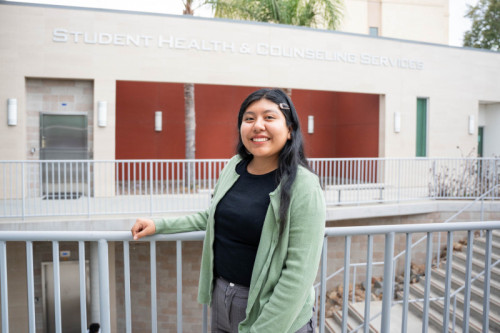
- Grant Helps Empower Future Mental Health LeadersAnahi Martinez Mendez has known since she was a teenager that she wanted to pursue a career helping children with mental health challenges. Martinez Mendez contended with social anxiety herself as a teen, and she was eager to ensure that her younger siblings knew there were resources and support systems to help if they faced similar challenges. “I was like their second mother, especially with my sister,” Martinez Mendez said. “It made me think, ‘How can I implement and help with mental health and related issues?’ Because growing up, I never really had the support system.” Martinez Mendez arrived at Cal State San Marcos initially planning to major in psychology and work toward becoming a clinical psychologist or family therapist. But working at Student Health & Counseling Services (SHCS) inspired her to pursue a slightly different path. Martinez Mendez spent two years during her undergraduate studies working in CSUSM’s HOPE & Wellness Center as a peer educator. The experience was life-changing, inspiring Martinez Mendez to pursue a Master of Social Work (MSW) degree at CSUSM after she graduated last May as a double major in child and adolescent development and Spanish. “I realized that I love doing more community outreach than working one on one,” she said. The HOPE & Wellness Center is among several groups on campus devoted to providing mental health services for CSUSM students. Last year, the university received a $250,000 grant from the Conrad Prebys Foundation to advance those services, part of a larger $6 million investment by the Prebys Foundation in grants to 23 local organizations. The Prebys Foundation’s funding helped CSUSM launch a mental health intervention program called the Community of Care that brings together the Cougar Care Network, SHCS and the Crisis Response Team. The grant also served as a catalyst for additional philanthropic support, including funding from the San Diego Foundation’s mental health program for MSW interns and a matching contribution from the Epstein Family Foundation. The Community of Care’s efforts to decrease mental health challenges and crises for students include the following strategies: Providing counseling through SHCS for students seeking mental health support. Providing basic needs resources and expanding mental health referral support through Cougar Care Network and its mobile Care Cart. Providing response to time-sensitive mental health crises on campus. Martinez Mendez is part of those efforts as a MSW graduate assistant this year for the HOPE & Wellness Center. She works closely with Cathy Nguyen, the coordinator of health promotion and a senior health educator, and Rosa Hunt, a health educator. Martinez Mendez became more interested in social work through her undergraduate work with psychology professor Aleksandria Grabow. It was Grabow who taught her about the many different areas that social work touches. A self-described introvert, Martinez Mendez also credits psychology professor Kimberly Vanderbilt for helping her grow and become more comfortable working with families. As a MSW student, Martinez Mendez attends classes two days a week while working 20 hours a week at schools in San Marcos Unified School District to earn her pupil personnel services credential, which authorizes individuals to work as school counselors, school psychologists or school social workers. It’s all part of her goal of becoming a school social worker or therapist to continue advocating for mental health for school-aged children. Visit the Student Health & Counseling Services website to learn about free mental health first aid trainings. SHCS will host the “Suicide Awareness Walk and Candlelight Vigil” on Sept. 25 at 5 p.m. Learn more about other upcoming events to support mental health on the SHCS events calendar. Media Contact Eric Breier, Interim Assistant Director of Editorial and External Affairs ebreier@csusm.edu | Office: 760-750-7314
- Scholarship Contender With Cystic Fibrosis ThrivingLola Ferguson was a regular at the hospital as a child. She was used to taking 50 pills a day, undergoing hours of treatments and numerous doctors’ appointments. It was just part of her normal daily life. “I was diagnosed with cystic fibrosis before I was even born,” Ferguson said. Also known as CF, cystic fibrosis is a genetic disorder that affects the body's mucus-producing glands, causing damage to the lungs, digestive system and other organs. Ferguson still takes medication and has treatments, but medical advances allow her to live a relatively normal life as a college student in her second year at Cal State San Marcos. In fact, Ferguson is doing so well that she is among the candidates for the AbbVie CF Scholarship, which honors students who are thriving with cystic fibrosis. Public voting accounts for about 30% of the evaluation. Supporters can vote for Ferguson online or by texting "VOTE23" to 35309 through Sept. 18. Winners will be announced Oct. 23. Other evaluation factors are based on academic record and extracurricular activities, an essay and a creative presentation. Ferguson received a $3,000 AbbVie scholarship last year and is hoping this year to win the top award, a $22,000 “Thriving Student Scholarship.” “AbbVie is a pharmaceutical company, and I have taken their meds in the past, so it was just sort of a household name for me,” Ferguson said. “To have a scholarship like that and be involved with a company like that is really nice.” In the late 1980s and early 1990s, the predicted survival age for people with cystic fibrosis was about 28 years old. Ferguson represents a new generation of young adults with CF who, thanks to medical advances, are living significantly longer. Life expectancy has improved to about 68, according to the Cystic Fibrosis Foundation. Ferguson has seen the improvements firsthand. The more than four dozen daily pills she took as a child is down to 20. She said CF primarily affects her lungs and digestive system, and she also has a mild case of diabetes related to it. In addition to the medication, she does an hour of daily treatment and closely watches her diet. “I don’t even drink caffeine,” she said. “I can’t miss out on my health because it’ll plummet really fast.” Ferguson has found a supportive environment at CSUSM. Disability Student Services ensured that she received a single room in campus housing, which was vital because of the daily treatment she requires. A literature and writing studies major, Ferguson was thrilled to land an on-campus job in Kellogg Library during her first year and she also started writing this fall for CSUSM’s student newspaper, “The Cougar Chronicle.” “I’ve learned to manage things and understand what I can and can’t do,” Ferguson said. “And I haven’t really had a problem in a long time because of all my treatments and medications.” Media Contact Eric Breier, Interim Assistant Director of Editorial and External Affairs ebreier@csusm.edu | Office: 760-750-7314
- CSUSM to Host Hispanic Heritage Month EventsIn celebration of National Hispanic Heritage Month, Cal State San Marcos’ Latinx Center is partnering with campus organizations to present an exciting lineup of events. The month, which runs Sept. 15-Oct. 15, is an opportunity to celebrate the rich culture and diverse backgrounds of Hispanic-identifying people. Everyone is invited to participate in Hispanic Heritage Month events. Chingona Fest Tuesday, Sept. 9 This two-part event celebrated and uplifted CSUSM's Latina-identifying students and their experiences. This year’s theme was Chingona Sin Frontiers, facing barriers in pursuit of education. Cafecito con Pan Monday, Sept. 15, noon, USU 3200 This series, hosted monthly in the Latinx Center, connects students with professionals across campus and offers opportunities for conversations over coffee and pan dulce. Latinx Center’s 10th Birthday Party Wednesday, Sept. 17, noon, USU 3200 To celebrate its 10-year anniversary, the center will host birthday party with games, cake and community. Raices de Barro: Talavera Workshop Tuesday, Sept. 23, noon, USU 3200 The Latinx Center will explore the roots of Mexican Talavera artwork and ceramics, with opportunities for students to create their own vase. Shared Roots: Tattoos in Our Cultures (With APIDA) Thursday, Sept. 25, USU 3200 An ongoing series in collaboration with the APIDA Student Center explores the cultural significance of tattoos in both APIDA and Latine communities. Chisme Club: Sin Fronteras Thursday, Oct. 2, noon, USU 3200 Students are invited to reflect on the impact of current events on our communities, with a self-care activity to end the session. Latine Heritage Month Celebration Thursday, Oct. 9, 5 p.m., USU Ballroom Join us as we close out the month with music, food and games at a celebration open to all. Media Contact Eric Breier, Interim Assistant Director of Editorial and External Affairs ebreier@csusm.edu | Office: 760-750-7314
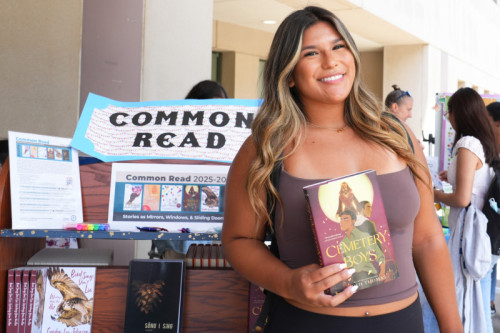
- New Common Read Theme Focuses on Empathy, Lived ExperiencesAfter three years of focusing on banned books, Cal State San Marcos’ Common Read will highlight stories that broaden perspectives and build empathy, according to CSUSM Academic Transitions Librarian Allison Carr. The theme for 2025-26, “Stories as Mirrors, Windows & Sliding Doors,” uses fiction and nonfiction books to provide insight into different lived experiences and encourages compassion and understanding. Students can pick up a free copy of a Common Read book from noon to 1 p.m. on the following dates: Sept. 18, Oct. 16, Nov. 13 and Dec. 4, in front of Kellogg Library. “We loved the banned books theme and we heard from a lot of students that they loved it, too. But after three years, we wanted to move on to a broader theme that reflected the current climate,” Carr said. “Given what we’ve seen in the news lately about a decline in reading, along with what we know about how reading encourages empathy and compassion, it was important that students gain a deeper understanding of people from all backgrounds.” Carr explained that Common Read considers the diversity of authors and genres as well as the interests of topics to undergraduate students when selecting the books. “While I’m excited about all of our books, this is the first year we’ve offered a collection of poems, ‘Song I Sing’ by Bao Phi. His poems, which are about immigration, race and class, feel a lot more accessible because of his slam poetry background,” Carr said. The library’s Student Advisory Board selected “Cemetery Boys” by Aiden Thomas as one of the books to be included. The story features a trans boy proving himself to his Latinx family, while also featuring elements of a love story and a paranormal investigation. The complete list of books selected for this year’s campaign is: “Bird Songs Don't Lie,” Gordon Lee Johnson “Daytripper,” Fabio Moon “The Remember Balloons,” Jessie Oliveros “Song I Sing,” Bao Phi “The Cemetery Boys,” Aiden Thomas (students' choice) “The View From Down Here: Life as a Young Disabled Woman,” Lucy Webster “Stories can break stereotypes, increase awareness of systemic issues and encourage respectful interactions with people from different backgrounds,” Carr said. “At a time when empathy and compassion are seen as weaknesses, reading can help us build and sustain a community that's inclusive and addresses the inequities marginalized communities currently face.” Common Read is also offering a zine-making workshop in collaboration with the Context Exhibit Series, “Zine Dreams” from 1-2 p.m. on Oct. 9 at The Makery. At the event, students can create a page in a collective zine that highlights their identities and stories. An RSVP is required. “My hope for this year is that students gain a deeper understanding of people who are different from them, but also a great understanding of themselves,” Carr said. Media Contact Eric Breier, Interim Assistant Director of Editorial and External Affairs ebreier@csusm.edu | Office: 760-750-7314
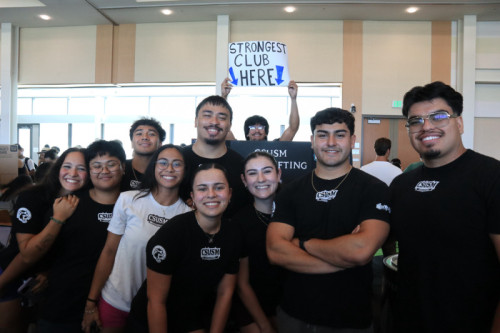
- Photo Highlights From Student Org FairCal State San Marcos welcomed hundreds of students to the University Student Ballroom on Sept. 4 for the annual Student Organization Fair. The event provides students an opportunity to learn about the many ways to get involved on campus. With more than 100 recognized student organizations in a variety of categories, there is something for everyone. Relive some of the event highlights in the Student Org Fair photo slideshow. To learn more about available student organizations, visit the student organization directory. Media Contact Eric Breier, Interim Assistant Director of Editorial and External Affairs ebreier@csusm.edu | Office: 760-750-7314