






29
January
2026
|
16:19 PM
America/Los_Angeles
By Rae Lynch
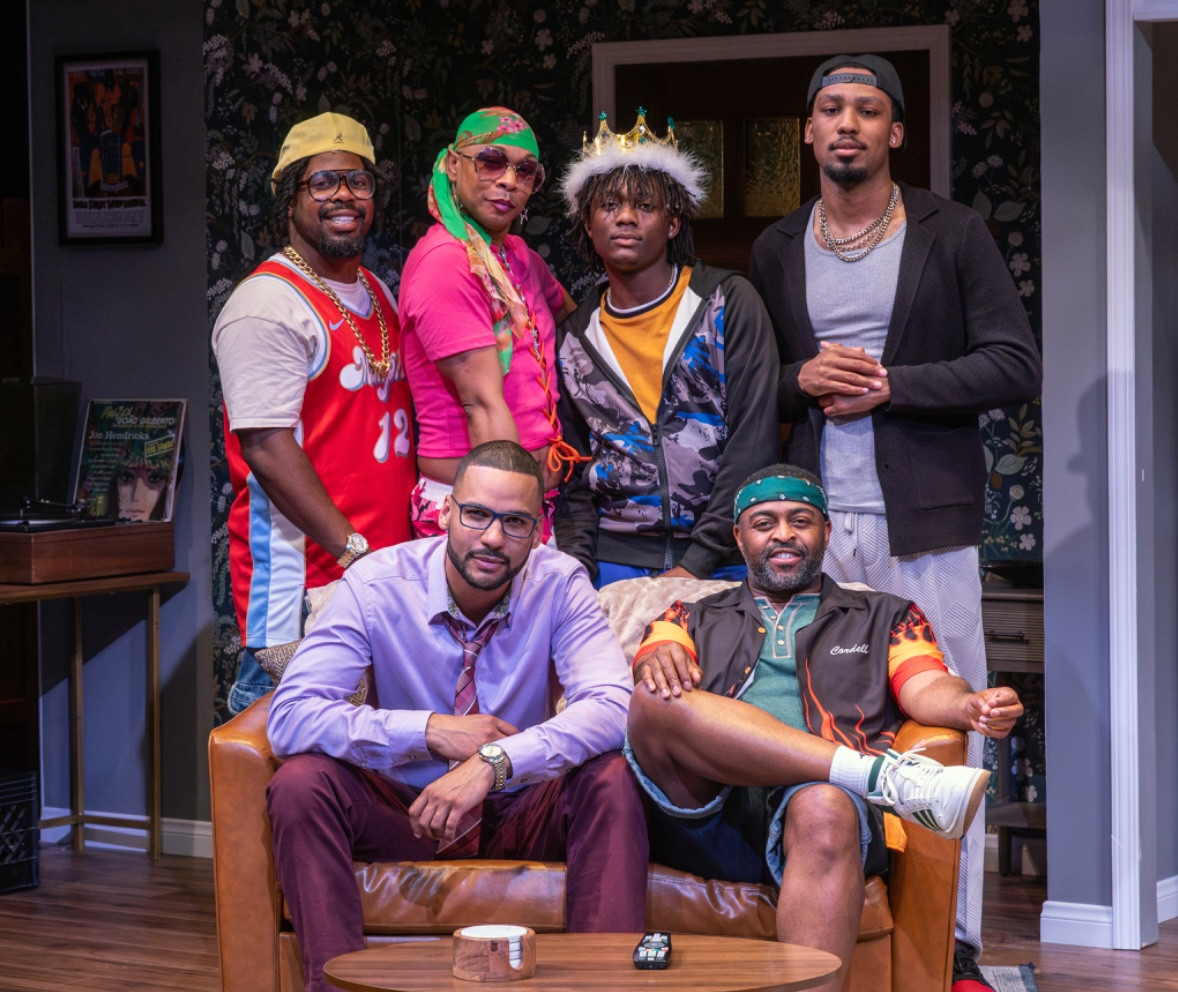
The cast of “The Hot Wing King” includes Kevane Coleman (back row, second from left), administrative support coordinator in CHABSS, who was nominated for a Craig Noel Award.
"; items += "
"; items += "
"; items += "
" + val['title'] + "
"; if(val['subtitle']){ items += "
" + val['subtitle'] + "
"; } items += "
"; if ((val['showpublishdate'] !== 0 && showPublishDateHeadlineSetting) || showPublishCityHeadlineSetting) { items += '
'; if (val['publishcity'] && showPublishCityHeadlineSetting) { items += '
' + val['publishcity'] + '
'; } if (val['showpublishdate'] !== 0 && showPublishDateHeadlineSetting) { items += "
"; items += "
" + date_month + "
"; items += "
" + date_day + "
,"; items += "
" + date_year + "
"; items += '
'; items += ' | '; items += '' + val['publish_time'] + ''; items += 'America/Los_Angeles'; items += '
'; items += '
'; } items += '
'; } items += "
" + val['message'] + "
"; items += "
Read more
"; items += "
"; items += ""; items += tags_items; items += multimedia_count; items += "
"; } }); items +="
"; if (1 > 1) { pp_jquery(".pp_blockheadlines_items-7643723").append(items); } else { pp_jquery(".pp_blockheadlines_items-7643723 .pp-headline-block").hide().css("opacity","0"); pp_jquery(".pp_blockheadlines_items-7643723").append(items); pp_jquery(".pp-headline-block:visible").animate({"opacity":"1"},300); } }); } pp_jquery(window).on('load', function() { /** * targets calcEqualHeights function (modules_v2h.js) * calculates consistent height for all visible items per block module */ pp_jquery('.pp_blockheadlines_items-7643723 .pp-headline-block').each( function() { PP_MODULES.calcEqualHeights(this); }); }); pp_jquery(document).ajaxComplete(function() { /** * when using block item nav button calcEqualHeights * function (modules_v2h.js) will be executed */ pp_jquery('.pp_blockheadlines_items-7643723 .pp-headline-block').each( function() { PP_MODULES.calcEqualHeights(this); }); });
Latest News Release
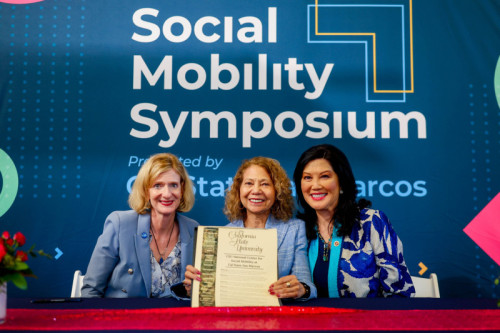
- CSU, CSUSM Launch National Center for Social MobilityThe California State University (CSU) and California State University San Marcos (CSUSM) have announced the launch of the CSU National Center for Social Mobility at CSUSM, a first-of-its-kind initiative that will advance the upward mobility of students across our nation. The announcement was made Friday, Feb. 6, following the 2026 National Social Mobility Symposium, hosted at CSUSM and livestreamed to audiences across the United States. The symposium annually convenes thought leaders and policymakers focused on how higher education can continue to be a driving force for students’ upward social mobility. Social mobility refers to the improvement of an individual’s socioeconomic status compared to previous generations. More than half of CSUSM students are first-generation college graduates. Late last fall, CSUSM was ranked No. 1 in CollegeNET’s Social Mobility Index for the second time in four years. Eight CSU campuses rank in the top 20 of the index. “Cal State San Marcos is honored to serve as the home of the CSU National Center for Social Mobility,” CSUSM President Ellen Neufeldt said. “This recognition reflects years of intentional work by our faculty, staff and students – and a deep commitment to being a university of place, with social mobility at the center of our mission.” CSUSM has secured $3 million in philanthropic donations to establish the center, including from the Stone Brewing Fund for Social Mobility, the Epstein Family Foundation and an anonymous donor – with each donating $1 million to the project. CSUSM Foundation Board Chair Simon Kuo presented a ceremonial check to CSU and CSUSM leadership Friday. The center is seeking additional philanthropic partners to ensure its sustained impact. Contact Jocelyn Wyndham, associate vice president of development, at jwyndham@csusm.edu for more information on partnership opportunities. About the Center The CSU National Center for Social Mobility at CSUSM, which is scheduled to launch in the 2026-27 academic year, is designed as a collaborative effort to advance student success and economic mobility practices in higher education at a national scale. “At its core, the center addresses one of the most urgent questions facing higher education today: How do we move from promising practices to proven systems that deliver results at scale?” CSU Chancellor Mildred García said. The social mobility center will serve as a national leader and convener in redefining student success beyond college access to include persistence, completion and career outcomes. The center will be based on three core pillars: Leading with best practices, including the identification, testing and scaling of strategies that remove barriers to graduation. Shaping the national dialogue, such as championing comprehensive student support as the foundation of upward mobility. Serving as a national hub for collaboration, which involves building partnerships with policymakers, educators, community organizations and industry. This center will provide avenues to participate in faculty-led research, innovation grants and fellowships; access to shared tools, data and best practices; and new paid internships and career-building opportunities for students. “At a time when higher education is being asked to demonstrate its value, the CSU is responding with action – by measuring outcomes, closing equity gaps and preparing the graduates who power our economy and enrich communities,” said Wenda Fong, trustee and past chair of the CSU Board of Trustees. “On behalf of the Board of Trustees, we are proud to support this center and the leadership of Cal State San Marcos in advancing this work nationwide. It’s a dream come true.” The announcement of the social mobility center was the culmination of the 2026 National Social Mobility Symposium, which this year took the format of a joint in-person event and webinar. With a theme of “Workforce and Economic Mobility: Higher Education’s Role in Driving Opportunity,” the program featured dynamic experts from across the country, addressing employer expectations, talent pipelines, systemic barriers to career readiness, and national policy and innovation driving mobility.
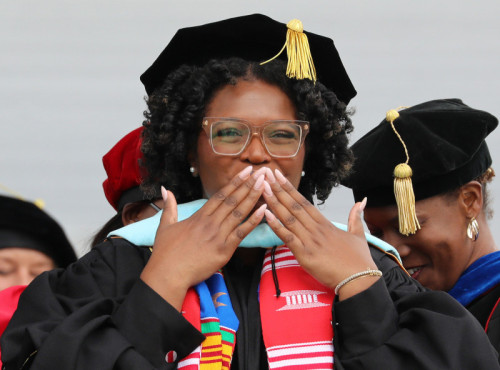
- Alumna, Former Employee Sees Personal Meaning in MentorshipShanelle Watkins often thinks about several previous iterations of herself. She thinks about the version who had just graduated from Cal State San Marcos and still harbored some self-doubt, unsure how she would turn her sociology degree into a career. She thinks about the version who set off for UC Davis as the first person in her family to attend college, but who couldn’t find the support that she needed and ultimately failed out. Most of all, though, she thinks about 12-year-old Shanelle, a Black girl from southeast San Diego (the “hood,” as she proudly calls it) who had her whole life ahead of her but also had already experienced her share of pain. Watkins even dedicated her doctoral dissertation to that Shanelle. “That’s when things started to click for me and a lot of questioning started to happen,” Watkins said. “That little girl, I just want to take and hold and heal. “I think that she probably would think I was really cool. I think she would really like me.” Now 36, Watkins is devoting her life to ensuring that other young girls – or, more precisely in her case, young women of color – can receive the mentorship that she sometimes got but occasionally eluded her, can achieve the success that she has attained despite the obstacles that dotted her path. Two years ago, Watkins left her job as assistant director of the Black Student Center at CSUSM – the university she had returned to almost a decade after graduating – to become director of the Chancellor’s Associates Scholarship Program at UC San Diego. CASP, as it's known, awards scholarships to and nurtures during their time at the university local and high-achieving students who come from low-income families – students, in other words, like young Shanelle. While she was working full-time at CSUSM and now UCSD, Watkins also was studying at both schools part-time, as an Ed.D. candidate in their joint doctoral program. Her dissertation, inspired by her experience running the Black Student Center for three years, explored the challenges faced by Black women student leaders at Hispanic-Serving Institutions within California State University. “I wanted to know what leadership meant to them,” she said. “How did it come about? Where was it rooted from? Through those questions, I heard very rich stories about the stress of code-switching or feeling like you need to assimilate to fit in or not being seen or being the token Black person in whatever organization or group you belong to.” She defended her dissertation and officially became Dr. Watkins, but she wasn’t finished with the subject. As an outgrowth of the project, last September she started a company called Leading While Becoming. The leadership organization offers quarterly group coaching cohorts and one-on-one coaching for women of color. She has built a roster of about a dozen clients, most of whom are women in their 20s who are trying to launch their careers. “I didn't foresee it happening this way,” Watkins said. “I thought my dissertation might be a toolkit to inform college leaders. I didn't think it would be a full-fledged coaching program. But I am glad, because it gives me the opportunity to meet with folks and empower them and watch them grow. It’s doing a lot of the things that I wish I had had.” What 12-year-old Shanelle did have was a love of education and a thirst for knowledge. What she didn’t have was financial resources or the most stable home life. Her mother, Augusta, was a stay-at-home parent who Watkins said did the best she could to raise her despite confronting personal challenges. Her father, Aaron, struggled with substance abuse problems before he got clean in a drug rehabilitation program and turned his life around. Aaron Watkins became Shanelle’s rock. After going sober, he got a job in facilities management at UCSD, where he worked nights cleaning science labs and offices for the next three decades. During the day, he worked (and still works) as a delivery driver for Pizza Hut. But he still found time to drive Shanelle to school every day, and to pick her up between his shifts. “Through his dedication to remaining sober and his hard work, I think he definitely instilled a lot of that in me,” Watkins said. In contrast to his other two children (Shanelle has an older sister and younger brother), who both played sports, Aaron Watkins recalls Shanelle being laser-focused on academics and ancillary activities – from being part of a radio broadcast with a classmate to serving on a drill team to doing a ride-along with the local police department. “She was involved in everything she could be,” Aaron Watkins said. “She was almost always self-motivated.” Her passion for learning, however, didn’t always come with a sense of belonging. When Watkins reached middle school, her family took advantage of a city program that allowed kids from disadvantaged neighborhoods to attend schools in wealthier communities. She went to Correia Middle and Point Loma High School, which both feature predominantly white student populations. “I questioned if I fit in there or if my family had the money to provide me with the things that I needed to thrive,” Watkins said. “For a little bit, it did kind of dim my light.” That light grew brighter in high school, when the canceling of her elective choir class because of low numbers led her to the Advancement Via Individual Determination (AVID) program, which is designed to prepare underrepresented students for college. On the first day, her teacher, Kellie Larson, told Watkins she would have to go to study hall and turn in notes every week. Watkins, feeling uncharacteristically rebellious, was less than enthused. “I was like, I’m not doing any of that,’ ” she said. “That whole first semester, her and I beefed so bad.” Larson persisted, pushing Watkins, encouraging her to take AP classes and sign up for clubs, handing her the tools to succeed that her parents didn’t know existed. By the time she graduated from Point Loma, Watkins had amassed more than $35,000 in scholarships. “Mrs. Larson and I are still in touch to this day,” she said. “If it weren’t for that choir class not having enough people, who knows where I would be now?” The appearance of mentors at just the right time would become a pattern for Watkins. After her academic withdrawal from UC Davis – “I was up against a lot of first-gen struggles,” she says – she returned home to attend MiraCosta College, then transferred to CSUSM. As a senior in fall 2012, she gave birth to her son, Seiji, and thought she might have to drop out, again derailing her academic ambitions. But a group of sociology professors – Watkins called out Karen Glover, Kathy Shellhammer, Sharon Cullity, Mary Roche and Gary Rollison – rallied to her side, pointing her toward maternal services, helping her postpone certain courses, letting her bring her baby to class. One even made a quilt for Seiji. “The faculty in the sociology department loved on me in places that I needed to be loved on,” Watkins said. “It made me really grateful for my CSUSM experience.” And when she came back to CSUSM as a staff member eight years later, in 2021, she discovered another invaluable mentor in Gail Cole-Avent, the university’s interim associate vice president for student health and wellness. Watkins says Cole-Avent, her supervisor, taught her how to occupy a leadership role without sacrificing her identity or sense of authenticity. Watkins’ return to CSUSM was the first in a series of gratifying full-circle moments that have marked the last few years. Her hiring at UCSD brought her to the place where her father worked for a generation before his retirement in 2019 – where she first learned what college was and how life-changing it could be. Even now, she encounters former colleagues of her dad, professors whose labs he cleaned, and they urge her to reach out if she ever needs assistance. Also, when Watkins decided that she wanted to add a board membership to her expanding resume, she sought out a San Diego nonprofit named CRASH (Community Resources and Self-Help). CRASH happens to be the organization that helped her father kick his drug addiction and begin his life anew way back when. In December, CRASH hosted a holiday party at one of its houses, and Watkins went with her dad, who had been invited as an alumnus of the program. “Everyone who he ran into, he was like, ‘This is my daughter, she’s on the board, she’s a doctor,’ ” she said. “My dad doesn’t smile a lot, but I could see the pride on his face.” And here’s one more full-circle moment. Watkins is a business owner, she’s a higher education administrator, she’s a leader. Above all, though, she’s a mother. Seiji is 13 now, almost the same age as the young Shanelle who Watkins often reflects on. He’s in seventh grade, he’s an ardent athlete and, like most teenagers, he thinks he’s too cool for his mom. “I was a single mom from the time he was three months old, and I would say I think I did a good job,” Watkins said. “He’s a wonderful kid and he’s my best friend. I see a lot of me in him. I always tell him, ‘You’re the greatest thing I’ve ever done.’ ” Media Contact Brian Hiro, Communications Specialist bhiro@csusm.edu | Office: 760-750-7306
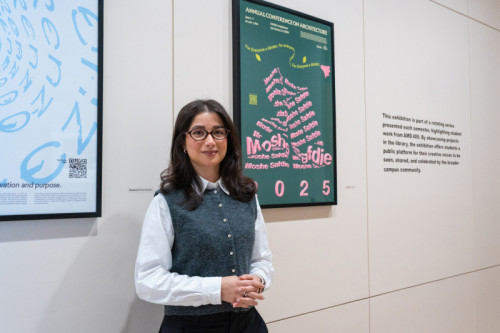
- New Gallery Showcases Student Art in LibraryThe event that inspired the class project was imaginary. But for Sonia Ellis and fellow Cal State San Marcos art students, the payoff was very real. Last year, Ellis was a student in AMD 409: Advanced Graphic Design and Visual Arts, an upper-division class taught by Ghazal Foroutan. The assignment: Using only typography, create a promotional poster for a hypothetical California architecture conference being hosted by CSUSM. The twist: Some of the posters that resulted would be displayed as part of a new student art gallery in Kellogg Library. Ellis made a poster about acclaimed Israeli-Canadian-American architect Moshe Safdie, and hers was one of 19 selected for the exhibit. “I was thrilled and honored to have my work chosen to be displayed in the library and kept in the archive,” said Ellis, an art, media and design major who’s scheduled to graduate this spring. “It gave a greater sense of purpose to the project.” The 19 posters compose the first installment of the Cougar Gallery, which is located on the library’s second floor, occupying the wall space between the Makery’s entrance and the stairwell down the hall. Foroutan said the idea came from a conversation with fellow art, media and design professor Kristin Moss, and it was brought to fruition through a collaboration with multiple employees of the library: associate dean Char Booth, outreach librarian Irma Ramos Arreaga, arts and humanities librarian Torie Quiñonez, and administrative coordinator Arely Ayala. The initial exhibit has adorned the library’s walls since the start of the fall semester. “Seeing the students’ work displayed in a prominent campus space has been incredibly meaningful,” Foroutan said. “As a professor, I am proud to share their work with the broader campus community and to see it recognized by the department and the library. “For students, the exhibition validates their efforts beyond the classroom. Many have already photographed their posters and plan to list the show as a group exhibition on their CVs, as well as include the work in their portfolios.” The Cougar Gallery, Booth said, fulfills a longstanding desire to increase the presence and visibility of student art in the library. As a prominent display of creative student work, it joins the Data Stacks on the library’s fourth floor. "By establishing this new gallery, we are showcasing the creative talents of CSUSM student artists and designers and dedicating a highly visible area of the library to School of Arts students and faculty as a much-needed supplementary gallery space,” Booth said. Once she was assigned Safdie as her subject (other famous architects featured include Frank Lloyd Wright and Frank Gehry), Ellis set out to make a poster that would promote a hypothetical discussion with the architect at the conference while also channeling the style and philosophy of that architect. In researching Safdie’s life and work, Ellis was drawn to his design theory, “For Everyone a Garden.” “He envisions architecture as a living, evolving environment, integrating gardens and green space into almost all of his designs,” she said. “That phrase became my guiding concept and tagline for the poster, inspiring my color palette and imagery.” Ellis incorporated both physical art and digital design in the creation of her poster. She also designed an accompanying booklet in the same style as the poster to round out the promotional material. “Over the weeks of working on the project, we all watched each other's concepts evolve in the studio, so seeing them printed professionally and displayed in a space where so many students pass through was very meaningful,” said Ellis, who plans to apply for the CSUSM teaching credential program, with a goal of becoming an art educator. Foroutan hopes to work with the library to rotate the exhibition at least once a year to showcase as many as much student artwork as possible. “While the overall framework of the project will remain consistent, I plan to subtly revise the assignment each year to introduce new constraints, tones or conceptual directions, allowing the exhibition to evolve over time,” she said. Media Contact Brian Hiro, Communications Specialist bhiro@csusm.edu | Office: 760-750-7306
- Donate to the Student Athlete Advisory Committee Basic Needs DriveThe Student Athlete Advisory Committee will be hosting a basic needs drive from Feb. 2-8 to donate to the local community. The SAAC is requesting donations, including warm clothing, nonperishable food items, household items, new hygiene products, etc. Donations will be accepted in the Clarke Field House suites as well as at upcoming CSUSM home basketball games. Free admission will be given to those who bring a donation. The committee will be collecting donations at REC Night ahead of the men’s and women’s basketball doubleheader, beginning at 5 pm. Follow its Instagram page, @csusm_saac, for more info and updates. Come support CSUSM's athletic teams and a good cause!
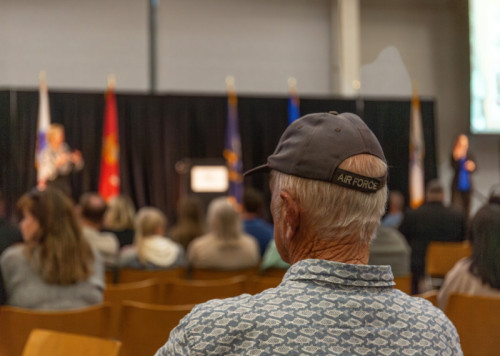
- CSUSM to Host Second Event Spotlighting Veterans' StoriesCal State San Marcos will host an event in April that will continue its initiative to preserve and amplify the stories of San Diego County military veterans through recorded oral histories. As part of the biannual Arts & Lectures series and in concert with community partner Veteran Lore, CSUSM will hold Veterans History Project II: The Journey Continues on Wednesday, April 8. The event builds on the success of the inaugural edition that took place last year; it’s co-hosted by Jason Beyer, a CSUSM double alumnus and U.S. Marine Corps veteran, and Marilyn Huerta, a CSUSM communications professional, double alumna and military-affiliated advocate. The program will share more of the work that’s included in the San Diego Veterans History Initiative, a project through the CSUSM library’s Special Collections department that reflects the university’s ongoing commitment to community engagement, veteran support and experiential learning. “The San Diego Veterans History Initiative is deeply personal for me as a Marine, an alumnus and now as a professional committed to serving our veteran community,” Beyer said. “These stories deserve to be heard, preserved and honored. By continuing this project and expanding it to include career connections, we’re not only reflecting on service, but actively supporting veterans as they transition and thrive beyond the military.” The evening will begin with a reception, resource fair and expanded career fair from 5-6 p.m., offering veterans and military-affiliated guests the opportunity to connect with campus departments, community organizations and employers interested in hiring veterans. The formal program will follow from 6-8 in the University Student Union ballroom on the CSUSM campus. The formal program will feature keynote speaker Jim Gruny, a U.S. Marine Corps veteran and retired colonel, followed by a film screening showcasing professionally recorded oral histories of veterans representing diverse backgrounds and service experiences. The recorded interviews will be archived in the CSUSM library’s Voices of North County collection and the U.S. Library of Congress, contributing to the national Veterans History Project and preserving veterans’ legacies for future generations. “This event is about creating space for stories, for connection and for opportunity,” Huerta said. “Veterans History Project II allows us to honor the lived experiences of veterans while building meaningful bridges to resources, careers and community. Preserving these stories through the CSUSM library Special Collections department and the Library of Congress ensures that their impact will extend far beyond one evening.” The oral histories this year will feature veteran stories from: Virginia F. Burke, U.S. Army (1968-70), first lieutenant (O-2) William D. Felty (CSUSM alumnus), U.S. Marine Corps (2003-07), corporal (E-4) Edmund Joseph Labrado Jr., U.S. Army (1969-70), captain (O-3) Joshua K. Loop (CSUSM alumnus), U. S. Coast Guard (2008-17), lieutenant (O-3) Dora L. Luevano, U.S. Marine Corps (1965-67), corporal (E-4) Thomas J. Moore (CSUSM alumnus), U.S. Marine Corps (1993-2019), master sergeant (E-8) ret. David B. Shaffer, U.S. Air Force (1963-67), captain (O-3) The event is open to the public, with free tickets available for CSUSM students and military-affiliated guests. Advance ticket reservations are encouraged. Organizations interested in hiring veterans are encouraged to reserve space in the career fair. For tickets and additional event information, visit the Arts & Lectures website.
- Black Student Center to Host Monthlong Black Excellence CelebrationAs Cal State San Marcos commemorates Black Excellence Month, the Black Student Center will host a series of events to celebrate the brilliance and resilience across CSUSM through arts, education, student engagement and community fellowship. The monthlong celebration will conclude with the annual Black Excellence Gala on Feb. 27. Black Excellence Month Kickoff Feb. 2, 11:30 a.m.-2 p.m., USU 2310 The Black Student Center (BSC) will kick off the celebrations with a brief presentation discussing the history of the Pan-African flag, a raising of the flag and a live drumline performance. Food will be provided at the event, which is open to all students. Def Jam Open Mic Night Feb. 5, 5-7 p.m., USU Amphitheater The BSC, in collaboration with the Cross-Cultural Center, invites students to enjoy a night of poetry, spoken word and music. The event is open to all students. Professional Styling: How to Tie a Tie Feb. 9, 1-2 p.m., USU 3300 As part of the “My Brother’s Keeper” initiative, the BSC will host a session of professional styling to teach students how to tie a tie. The event is open to all students. Sista Fest Feb. 10, 5-7 p.m., USU 2310 In collaboration with the Women and Gender Equity Center, the BSC will host an event to celebrate Black women on campus. This year’s theme, “Rooted and Radiant,” is focused on providing mentorship to young Black women looking to navigate professional spaces. The keynote speaker is Wendy Stewart, MiraCosta College’s chief diversity officer. The event is open to all students. Black Jeopardy Game Night Feb. 13, 5-7 p.m., USU Ballroom Students are welcome to join the BSC for a night of culturally relevant games. Food will be provided on a first-come, first-served basis. Carnaval Feb. 18, 5-8 p.m., USU Ballroom Join the BSU and the Latinx Center for a celebration of dance and heritage from various communities across Latin America and the African diaspora. The event will feature live music, cultural foods and mask painting inspired by Rio de Janeiro’s Carnaval and New Orleans’ Mardi Gras festival. Ebony Fashion Show Feb. 20, 5-8 p.m., USU Ballroom The inaugural Ebony Fashion Show will provide a space for students to showcase their elegance on the runway. The event will highlight the creative expression of students across CSUSM student centers to showcase cultural displays through fashion. Black Org Fair Feb. 25, 5-7 p.m., Forum Plaza All students are invited to learn about the various Black student organizations at CSUSM. Representatives will be featured from various academic, social, faith-based and national Panhellenic Council organizations. 2/27 Black Excellence Gala Feb. 27, 5:30-8:30 p.m., USU Ballroom As the finale of Black Excellence Month, the BSC will host an inaugural event in collaboration with Tukwut Life to celebrate and highlight the Black community. The evening will showcase achievements and inspiring stories from the community, followed by a student performance and live DJ. Guests are encouraged to dress in their finest attire to honor the occasion and the remarkable accomplishments being celebrated. Media Contact Eric Breier, Interim Assistant Director of Editorial and External Affairs ebreier@csusm.edu | Office: 760-750-7314